
For countries heavily reliant on international commerce, a border is far more than a line on a map—it acts as a direct tollbooth on the entire economy. Malaysia and Thailand are prime examples of this reality. According to World Bank data, trade openness is worth roughly 137 percent of GDP in both nations, placing them…

Weekly Report
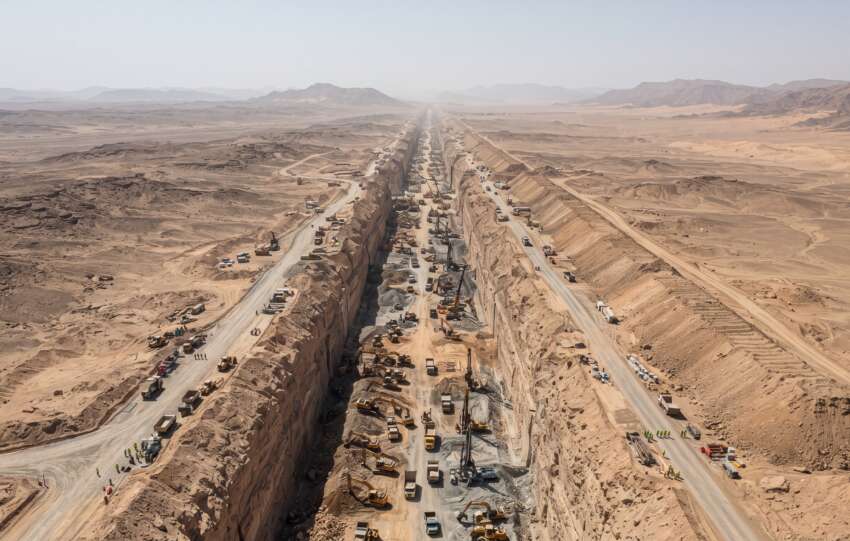
Is the massive restructuring of Saudi Arabia's ambitious Vision 2030 giga-projects a sign of a binding fiscal constraint, or is it evidence of strategic learning and intelligent reallocation? For global portfolio managers, macro strategists, and development finance allocators, this is the central question of the Saudi macro position.
Our latest research study explores this exact…
For decades, environmental advocacy was a battle fought on the ground—at the fence line of construction sites and along the pathways of planned infrastructure. But when the controversial East African Crude Oil Pipeline (EACOP) was pursued despite widespread local displacement and international resolutions, a fundamental shift occurred. Activists realized they couldn’t stop the pipeline at…
Is a new trade architecture quietly reshaping how Africa feeds itself—and how its debt is priced?
Over a thousand years ago, Oman sat at the center of the Indian Ocean monsoon trading system—a vast, multi-currency commercial network linking East Africa, southern Arabia, western India, and Southeast Asia. No single empire controlled it. No single currency dominated it. It…
In an era where sudden political shifts often trigger immediate market panic, how do certain nations maintain steady economic momentum? For policymakers, investors, and observers of the Global South, understanding the gap between political noise and economic reality is more critical than ever. Our latest research report dives deep into Chile’s remarkable economic trajectory, exploring…
Global supply chains are currently navigating a period of unprecedented fragility. With container traffic through the Red Sea and Bab-el-Mandeb strait already plummeting by 75% due to ongoing regional conflicts, the systemic pressure on alternative maritime and overland corridors has reached historic highs. But what happens if the world’s most critical energy artery faces a…
Uzbekistan’s accession to the BRICS New Development Bank is more than a diplomatic headline. It raises a deeper question for anyone interested in development, sovereignty, and economic transformation: does NDB membership give Uzbekistan real financing autonomy, or does it simply repackage familiar de-risking models under a new flag?
Our new advocacy brief explores that…
The Formal-Sector Cost of Iran Sanctions is a research brief showing that repeated sanctions shocks have measurably reduced capability formation in Iran’s formal manufacturing sector, while parts of the parastatal economy appear to have absorbed much of the substitution. The study also finds a partial post-2024 currency shift in trade settlement, but argues that this does…
For decades, the global economy has operated on a financial infrastructure that was built for a different era. Today, as geopolitical fractures deepen, the vulnerabilities of relying on a single, Western-led payment messaging system have become impossible to ignore. When access to the global financial system is used as a geopolitical lever, the need for…