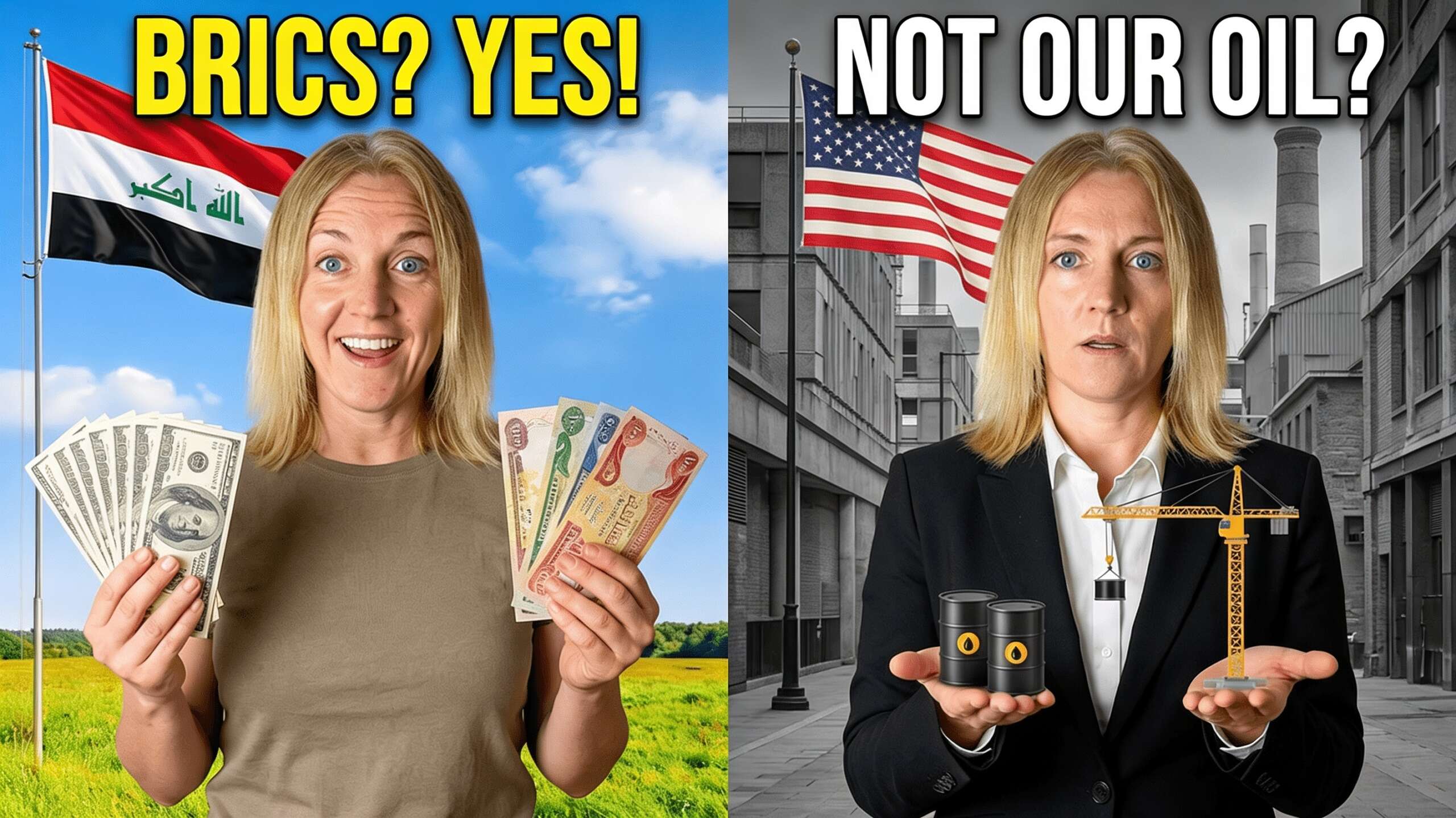

Why Nobody is Talking About Iraq’s New BRICS Strategy
Since the 2003 invasion, Iraq’s sovereign oil export revenues have been deposited directly into the Federal Reserve Bank of New York—a financial architecture that transforms a nation’s wealth into a lever of foreign control. Officials in Baghdad estimate that between $80–85 billion of Iraq’s oil revenues are now held at the U.S. Federal Reserve. This is not sovereignty. It is financial trusteeship—and it is the single most important fact omitted from every mainstream headline about Iraq’s future.
Western media coverage of Iraq’s BRICS aspirations follows a predictable script: Iraq is a U.S. ally considering a “pivot” toward Beijing and Moscow, presented as an act of diplomatic hedging or, at worst, ingratitude. The Times of India frames it as a “possible blow to Trump”; mainstream outlets reduce the story to geopolitical theater between Washington and its rivals.
What they systematically omit is the structural reality of Iraq’s financial subjugation. Since 2003, the U.S. has maintained de facto control over Iraq’s oil dollar stream. The Federal Reserve ships physical dollar pallets from New York to Baghdad—up to $13 billion annually—giving Washington direct leverage over Iraqi public salaries, currency stability, and ultimately, political outcomes. In early 2026, the U.S. suspended dollar shipments to pressure Baghdad over Iranian influence. This is not diplomacy. This is financial coercion weaponized as statecraft.
The mainstream narrative frames Iraq’s BRICS interest as a choice between allies. It is not. It is a survival strategy born of two decades of dollar dependency that has left Iraq’s economy hostage to Washington’s political whims.
From Baghdad’s vantage point, BRICS membership is not about abandoning the U.S.—it is about reclaiming agency. Iraqi Ambassador to Russia Dr. Abdul-Karim Hashim Mostafa confirmed that joining the expanded group is “a good idea” as Iraq looks to diversify partnerships beyond Washington. With neighbors Iran and the UAE already full members, Iraq is integrating into a multipolar economic matrix.
The centerpiece of this strategy is the Iraq Development Road—a $17 billion infrastructure megaproject connecting the Grand Faw Port in Basra to the Turkish border via 1,200 kilometers of rail and highway. Dubbed the “Suez Canal on land,” it aims to link the Gulf to Europe through an integrated transport corridor. Iraqi officials have explicitly expressed interest in twinning this project with China’s Belt and Road Initiative.
This is not abstract geopolitics. By mid-2026, the U.S. dollar and euro jointly account for less than 30 percent of transaction settlements among BRICS members, while local currency transactions have risen to 65%. BRICS now represents over 35% of global GDP and roughly 45% of the world’s population, with 23 nations holding active membership applications. Iraq’s BRICS ambition is a calculated move to align with the gravity center of the global economy—not an impulsive break from the West.
For policymakers and analysts, the Iraq case offers a diagnostic template for how petrostate sovereignty is being renegotiated in the multipolar era. The dollar pallet system is not a relic of the 2003 occupation—it is an active mechanism of control that the U.S. continues to deploy. Any Global South nation with oil revenues held in Western financial institutions should recognize this as a structural vulnerability.
Here is the observation that sets Think BRICS apart: Iraq’s BRICS strategy is not primarily about trade diversification—it is about fiscal decolonization. The Development Road is not merely an infrastructure project; it is a physical bypass around the U.S.-controlled financial corridor. By routing trade through a China-connected overland network and settling in non-dollar currencies, Iraq is systematically de-linking its economy from the Federal Reserve’s leverage point. This is sovereignty by infrastructure.
For decision-makers, the actionable insight is clear: BRICS membership offers a hedging mechanism against dollar weaponization, but it requires concrete, bankable projects—not just diplomatic gestures. Iraq’s model—infrastructure-first, currency-diversification-second—offers a replicable blueprint for other resource-rich Global South nations seeking to escape the petrodollar trap.
Iraq’s pursuit of BRICS membership represents the most significant challenge to U.S. financial hegemony in the Middle East since the 2003 invasion—not because Baghdad seeks confrontation, but because twenty-three years of dollar dependency have left it with no alternative. The $17 billion Development Road and the 65% local currency settlement rate within BRICS are not abstract statistics; they are the building blocks of a post-dollar order. For analysts and policymakers, Iraq is the canary in the coal mine of petrostate sovereignty—and the coal mine is collapsing.